
Almost every foreign-owned company in Vietnam meets the e-invoice system in the same order: first as a surprise (you cannot just print an invoice), then as a monthly chore (someone has to go and fetch the supplier invoices), and finally as an audit problem (the books and the portal do not agree).
This article walks through how the system actually works and where the effort really sits.
The shape of the system
Vietnam runs a centralised electronic invoice regime. Invoices are not private documents exchanged between two companies — they are registered with the tax authority, which holds a copy.
Since 1 July 2026 the regime has operated under Decree 254/2026/ND-CP and Circular 91/2026/TT-BTC, which replaced Decree 123/2020 and Decree 70/2025.
Two practical consequences flow from centralisation, and they pull in opposite directions:
- Issuing is constrained. You cannot generate a compliant invoice yourself.
- Retrieving is possible. Because the authority holds every invoice issued to your tax code, your input invoices exist in one place whether or not your supplier remembered to email them.
The second point is the one most companies under-use.
Output invoices: issued through a licensed provider
When you sell, the invoice is issued through an organisation that has contracted with the tax authority to receive, transmit and store e-invoice data. This is a licensed role, and the list of providers is published and changes over time. Common names include SInvoice, BKAV and FPT.
What that means for your stack:
- Your foreign accounting platform cannot issue the invoice. It can record it after the fact.
- If your Vietnamese accounting system integrates with a licensed provider, issuing and recording are one step. If it does not, they are two, and the two can drift apart.
Input invoices: the part that costs hours
Here is the workflow at most companies, described honestly:
- Late in the month, someone logs in to
hoadondientu.gdt.gov.vnwith the company's tax credentials. - They filter to the period and export the list.
- They download the invoice data — XML files, sometimes hundreds of them.
- They enter or import each one into the accounting system.
- They chase whatever is missing, because a supplier issued late or the download timed out.
Step 4 is where the difference between formats matters. The PDF rendering of an invoice is for humans. The XML is the structured record — line items, quantities, tax rates, the reference chain to any invoice it replaces or adjusts. A system that reads XML can build the entry without anyone retyping it. A person working from PDFs is doing data entry, invoice by invoice.
For a company with two hundred purchase invoices a month, this single workflow is usually the largest line in the bookkeeping budget — and it is entirely mechanical.
Replacements and adjustments
Vietnam does not handle corrections by editing an invoice. A correction is itself an invoice that points back at the original: either a replacement invoice, which supersedes it, or an adjustment invoice, which changes a specific figure.
Your ledger has to follow that chain. If your accountant simply overwrites the original amount, the books stop reconciling to what the tax authority holds — and the discrepancy will not be obvious until someone compares the two, which is usually the auditor, eleven months later.
Why reconciliation should be monthly, not annual
Three things go wrong when the ledger and the portal are only compared at year end:
- Input VAT you never claimed. An invoice that never made it into the books is deductible VAT you paid and did not recover.
- Deductions you cannot support. An entry in the books with no matching invoice on the portal is a deduction the tax authority may disallow.
- A worse audit. Foreign-invested enterprises must have annual financial statements audited by an independent audit firm under the Law on Independent Audit 67/2011/QH12 and Decree 17/2012/ND-CP. Auditors reconcile against the tax authority's records. Gaps found in March are gaps you no longer have time to fix.
Reconciling every period turns all three into small, cheap corrections. Reconciling annually turns them into findings.
What good automation looks like here
The reason this workload persists is not that it is hard. It is that the retrieval step is manual by default — someone has to decide to go and get the invoices.
Vietbooks removes that decision. It fetches your input invoices from the tax authority automatically, every night, and backfills from the start of the year, so the ledger tracks the portal continuously instead of in a monthly scramble. You still choose specific date ranges to re-sync when you need to; you just do not have to remember to.
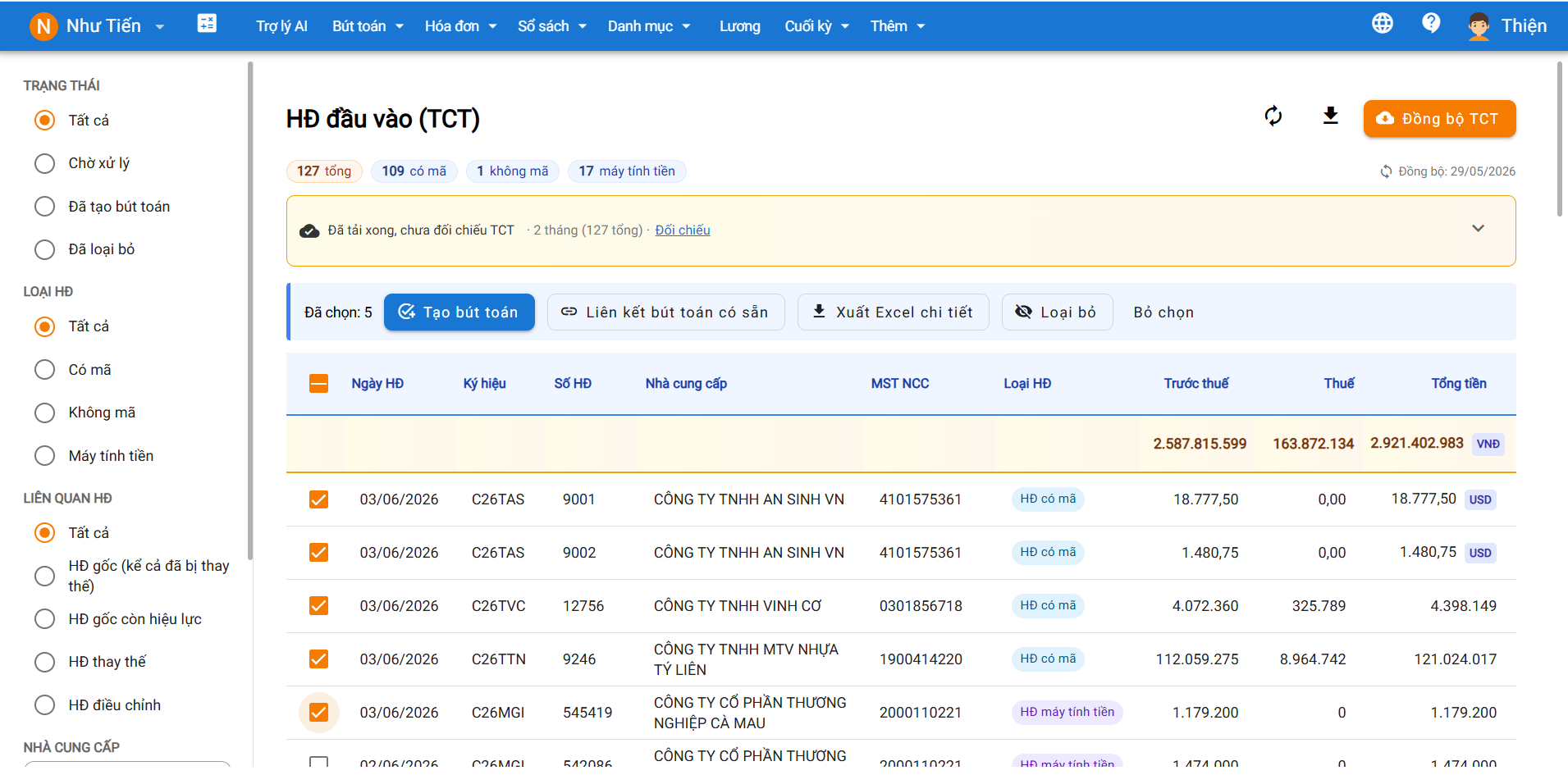
From there:
- Invoices arrive as structured data, so line items, tax rates and totals post without retyping.
- Replacement and adjustment invoices come through with their reference chain intact, so the ledger follows the correction rather than obscuring it.
- Because the same system keeps the statutory books in Vietnamese and VND and issues e-invoices through approved providers, there is no second tool to reconcile against.
Free for 30 days, no card required. Start a trial.
Read next
- Bookkeeping in Vietnam: what a foreign-owned company actually has to do
- Can you run QuickBooks or Xero in Vietnam?
- Outsourced accounting in Vietnam vs hiring in-house
This article is general guidance, not legal or tax advice, and reflects the position as at August 2026. It refers to Decree 254/2026/ND-CP and Circular 91/2026/TT-BTC on electronic invoices (effective 1 July 2026, replacing Decree 123/2020 and Decree 70/2025), and to the Law on Independent Audit 67/2011/QH12 and Decree 17/2012/ND-CP. The list of licensed e-invoice service providers is published by the tax authority and changes over time; confirm the current position before relying on it.